
Urging Naxals to shun violence, Shah announced that the Chhattisgarh government would announce a "new look" surrender policy in 1-2 months.

Security forces killed 14 Naxalites, including wanted ultras Mangtu (DVCM) and Hunga Madkam, in separate encounters in Chhattisgarh's Sukma and Bijapur districts in the Bastar region on Saturday, officials said.

Two Naxalites, carrying a collective reward of Rs 7 lakh, were killed in an encounter with security forces in Bijapur district of Chhattisgarh. The operation was launched based on inputs about the presence of Maoist cadres in the area.

Union Home Minister P Chidambaram, who inaugurated the DGPs/IGPs Conference in New Delhi on Thursday, accepted the responsibility for violent Naxal incidents and said it was the government's duty to set out the context in which such terrorist attacks take place.
Jawaharlal Nehru University (JNU) has sought a first information report (FIR) after students allegedly raised 'provocative' slogans against Prime Minister Narendra Modi and Union home minister Amit Shah inside the university campus during an event on Monday night, varsity officials said.

Union Home Minister Amit Shah rejects the ceasefire offer from Maoists, stating that surrender is the only option. He also addresses Naxalism's ideological roots and progress in Jammu and Kashmir and the Northeast.
The Gadchiroli district bordering Andhra Pradesh and Chhattisgarh has been the hot-bed of Naxal activities in Maharashtra with the Maoist violence claiming 418 lives in the past three decades.
Modi said the situation is rapidly changing and a new era of peace is setting in Naxal-affected areas.
The Maharashtra legislative assembly passed the 'Maharashtra Special Public Security Bill' aimed at preventing unlawful activities of Left Wing Extremist organizations, focusing on urban Naxalism and passive militancy.

RSS chief Mohan Bhagwat addressed concerns about population imbalance, citing religious conversion, infiltration, and low birth rates as key factors. He advocated for 'ghar wapasi' and vigilance against infiltrators, while also emphasizing the importance of family and employment.
India has strongly protested the inclusion of the Naxal issue under the realm of 'armed conflict' in a United Nations report, saying the violence being perpetrated by these groups does not make it a zone of armed conflict, as defined by international law.
The first prime minister to visit this Maoist hotbed in three decades, Narendra Modi on Saturday asked Naxals to abjure gun and allow peace so that the macabre drama of death will end to pave the way for development.
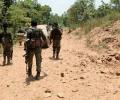
A hill with an altitude of 5,000 feet, once a hub of the Maoists along the Chhattisgarh-Telangana border, was reclaimed by the security forces after driving out the extremists following nine days of intense anti-Naxal operation, official sources said.

'For the remaining Maoist cadres, they shall soon confront one of two outcomes: Either surrender or face neutralisation.'

The Maoists in Bastar went from one village to another with kits providing badly needed medical intervention. The medical help was one key reason why the tribals were attracted to the Maoists, points out M R Narayan Swamy.

Union Home Minister Amit Shah has stated that Naxalism, currently confined to just four districts in India, will be completely eradicated by March 31, 2026. He emphasized the crucial role of the Central Reserve Police Force (CRPF), particularly its CoBRA battalion, in achieving this goal. Shah lauded the CRPF's contributions to national security, highlighting their efforts in combating terrorism in Kashmir, maintaining peace in the Northeast, and significantly reducing Naxal violence. He also paid tribute to the CRPF's sacrifices, acknowledging the loss of 2,264 personnel in the line of duty.

'From every point of view, they have faced an extremely difficult couple of years, and the setback they have suffered is irreversible.' 'This reality has begun to set in even amongst the top-level cadres. That is why, in recent times, we have witnessed a huge number of senior-level cadres emerging from the jungle and deciding to renounce violence and join the mainstream.'

70 per cent voting was recorded across 18 constituencies of Bastar and Rajnandgaon till 3 pm in the first phase of assembly election in Chhattisgarh, where violence by Naxals who have called for a poll boycott left a Central Reserve Police Force jawan dead.

A violent clash broke out between two groups of students at Jawaharlal Nehru University (JNU) campus on Friday during a 'Visarjan Shobha Yatra' organised on the occasion of Vijayadashami, following the nine-day Navratri celebrations.
2008 will go down in the annals of history for the lowest ever incidents of left wing violence in Andhra Pradesh as the state police and its elite wing Greyhounds managed to establish a clear upper hand over the armed rebels. State director general of police Shyamsundar Prasad Yadav in his year-end report said that there was a 30 percent decline in the extremist offences in the state over 2007.

Chhattisgarh Chief Minister Vishnu Deo Sai announced that North Bastar and Abujhmad regions are now free of Naxal violence, with the fight against Naxalism in South Bastar reaching a decisive phase. He attributes this success to trust-building measures and the surrender of Naxal cadres.
The year 2009 has been one of the most peaceful years, as far as Maoist violence in Andhra Pradesh was concerned. The state director general of police R Girish Kumar told a year-end press conference that Andhra Pradesh police had emerged as a role model for the other states in dealing with the Maoist problem.
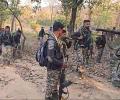
The troops of 209 Commando Battalion for Resolute Action (CoBRA) conducted the operation in which eight Naxals were killed and an AK series rifle, three INSAS rifles, a self-loading rifle (SLR), eight country-made guns and a pistol were seized, the officials said.
Naxal violence claimed maximum lives this year as compared to terrorist and insurgency incidents in Jammu and Kashmir and the northeast, the government on Tuesday told Parliament.

Prime Minister Narendra Modi asserted his commitment to eradicating Maoist terror from India, criticizing the previous Congress regime for allegedly supporting 'urban Naxals' and ignoring the violence they perpetrated. He highlighted the significant reduction in Maoist-affected districts and the surrender of numerous Naxalites as evidence of his government's success in combating the issue.

'The watershed moment was June 22, 2024, when the divisional in-charge of Gadchiroli, Giridhar Tumreti, who was their senior-most commander, along with his wife, came forward to surrender before the then deputy chief minister and home minister Devendra Fadnavis.'

The Congress's performance in the Lok Sabha elections showed that it may be down but not out, and Modi is determined to ensure that in the next round in 2029, it is consigned to irrelevance, points out Saisuresh Sivaswamy.

Terming Naxals the biggest human rights violators, Union Home Minister Amit Shah on Monday said security forces have been carrying out 'offensive operations' instead of defensive against the insurgents and have achieved big successes in recent times.

Maharashtra Chief Minister Devendra Fadnavis has re-introduced the Special Public Security Bill in the state assembly, aiming to combat 'urban Naxalism'. The bill, which seeks to criminalize activities deemed to disrupt public order, has faced criticism from opposition parties who argue it could stifle dissent. The proposed law will be referred to a joint select committee for review and is expected to be passed in the monsoon session next year.

According to Misri's statement, Modi said he could not accept the invitation due to a pre-existing schedule, and invited Trump to visit India for the Quad Summit, likely later this year.

Senior Maoist leader Mallojula Venugopal Rao alias Bhupathi surrendered to police in eastern Maharashtra's Gadchiroli district after negotiations. He was a founding member of the People's War Group (PWG) and carried a bounty of Rs 6 crore on his head.
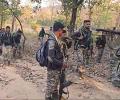
Chhattisgarh Deputy Chief Minister Vijay Sharma has reiterated the state government's willingness to engage in unconditional peace talks with Naxalites, following a statement by the Maoist group outlining preconditions for a ceasefire. Sharma, who holds the home portfolio, stated that the government has already made its stance on unconditional talks clear and has implemented a surrender and rehabilitation policy for Naxal cadres. He criticized the Maoists' demands as unreasonable and emphasized the importance of ending violence and joining the national mainstream. Sharma also called on the Naxalites to send a representative if they are serious about peace talks, but ruled out the formation of a separate committee for negotiations. The Maoist statement, released in Telugu, highlighted the group's concerns regarding intensified counter-insurgency operations and alleged human rights violations. They appealed for a positive atmosphere for peace talks, calling for a halt to anti-Naxal operations and the establishment of new security camps.
Another jawan was injured in the incident. Naxalites shot dead two Salwa Judum leaders Hapka Ayatu and Palli Pandu yesterday in Kader and Kandulnar villages of Bijapur district, police said.
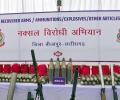
Chiefs of Central Reserve Police Force and Chhattisgarh police, GP Singh and AD Singh respectively, along with senior commanders of the two forces addressed the media in this district, about 450 km from state capital Raipur, to assert that the top armed Maoist leadership was "either eliminated or injured".
Prime Minister Narendra Modi asserted that the record turnout in the first phase of the Bihar assembly polls indicates people's trust in the NDA government. He predicted victory for the NDA, led by Chief Minister Nitish Kumar, and lauded the Election Commission for conducting successful elections.

Many IEDs explode even when the troops are on foot and their trigger mechanism gets activated just due to the pressure of the feet. These incidents have injured more than 100 personnel over the last two years, the officer said.

Three battalions of the Border Security Force comprising more than 3,000 personnel will move across the border from Odisha to Chhattisgarh and an equal number of Indo-Tibetan Border Police units will further move into the Naxal stronghold of Abujhmad as part of a strategy to intensify anti-Maoist operations in their last bastions, official sources said.

210 Maoist cadres, including a Central Committee member, surrendered to authorities in Chhattisgarh's Jagdalpur, marking the "largest mass surrender" in the state's anti-Naxal operations. The surrendered Naxalites carried a collective bounty of Rs 9.18 crore and handed over 153 weapons. Chief Minister Vishnu Deo Sai hailed the development as a historic moment for Chhattisgarh and the nation.
Strengthening of counter terror capabilities and the intelligence apparatus, Maoist violence, police reforms and capacity building will be high on the agenda at the chief ministers' conference on internal security, which will be inaugurated by Prime Minister Manmohan Singh in Delhi on Monday. The day-long conference will also deliberate on how India is being affected due to its troubled neighbourhood and its obvious consequences in the country like cross-border terrorism.

'Today we know of many X, Y, and Z persons as urban Naxals but can we call these people as such?' 'No, we cannot because we don't have a legal framework for doing that.'
